Ứng dụng mô hình điện dung - điện trở mở rộng vào vỉa bơm ép nước
Tóm tắt
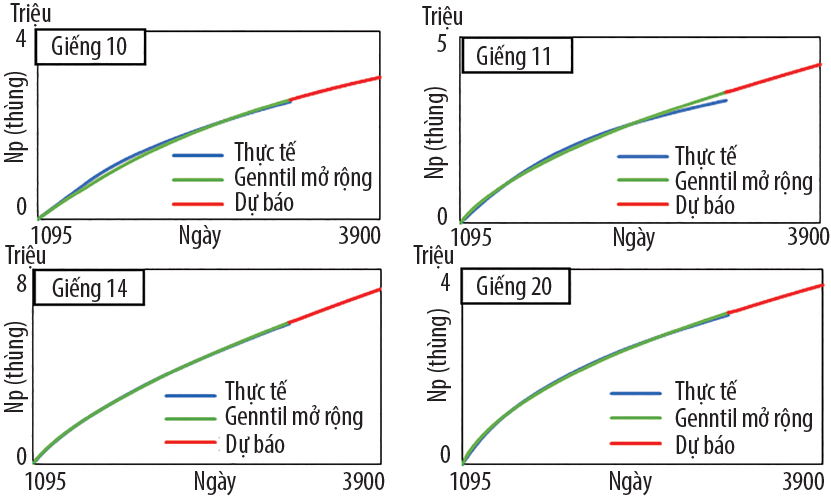
Nghiên cứu phát triển mô hình điện dung - điện trở mở rộng (CRMe, Extended capacitance - resistance models) cho vỉa dầu ở bể Cửu Long, nơi nguồn năng lượng tự nhiên tác động gây nhiễu đến cơ chế năng lượng bơm ép nước, ảnh hưởng đáng kể đến độ tin cậy của kết quả dự báo. Nhóm tác giả đã xây dựng và kết hợp mô hình CRMe và Gentil mở rộng, dự báo tổng sản lượng khai thác cộng dồn sát với số liệu thực tế, từ đó dự báo nhanh tổng sản lượng thu được từ vỉa trong 805 ngày tiếp theo là gần 3,14 triệu thùng dầu.
Các tài liệu tham khảo
[2] Byron Wiess, O.L.Patterson, and K.E.Montague, "High-speed electronic reservoir analyzer", Drilling and Production Practice, New York, 1 January 1951.
[3] W.L.Wahl, L.D.Mullins, R.H.Barham, and W.R.Bartlett, "Matching the performance of Saudi Arabian oil fields with an electrical model", Journal of Petroleum Technology, Vol. 14, No. 11, 1962.
[4] Alejandro Albertoni and Larry W.Lake, "Inferring interwell connectivity only from well-rate fluctuations in waterfloods", SPE reservoir evaluation & engineering, Vol. 6, No. 1, 2003. DOI: 10.2118/83381-PA.
[5] Pablo Hugo Gentil, “The use of multilinear regression models in patterned waterfloods: Physical meaning of the regression coefficients”, University of Texas at Austin, 2005.
[6] Ali Abdallah Al-Yousef, "Investigating statistical techniques to infer interwell connectivity from production and injection rate fluctuations", University of Texas at Austin, 2006.
[7] Larry W.Lake, Ximing Liang, Thomas F.Edgar, Larry Lake, Ali Al-Yousef, Morteza Sayarpour, and Daniel Weber, "Optimization of oil production base on a capacitance model of production and injection rate", Hydrocarbon Economics and Evaluation Symposium, Dallas, Texas, U.S.A.,
1 - 3 April 2007. DOI: 10.2118/107713-MS.
[8] Morteza Sayarpour, “Development and application of apacitance-resistive models to water/CO2 floods”. University of Texas at Austin, 2008.
[9] Nguyễn Văn Đô, Trần Văn Tiến, Trần Nguyên Long và Lê Vũ Quân, “Áp dụng mô hình điện dung đánh giá mức độ ảnh hưởng của giếng bơm ép tới giếng khai thác”, Tạp chí Dầu khí, Số 7, tr. 28 - 36, 2019.
[10] Mohammad Sadeq Shahamat, “Production data analysis of tight and shale reservoirs”, University of Calgary, 2014. DOI: 10.11575/PRISM/27446.
[11] Fei Cao, “Development of a two - phase flow coupled capacitance resistance model”, University of Texas at Austin, 2014.
[12] Daniel Brent Weber, “The use of capacitanceresistance models to optimize injection allocation and well location in water floods”, University of Texas at Austin, 2009.
[13] Rafael Wanderley De Holanda, “Capacitance resistance model in a control systems framework: A tool for describing and controlling waterflooding reservoirs”, Texas A&M University, 2015.
[14] Nguyen Anh Phuong, “Capacitance resistance modelling for primary recovery, waterflood and water - CO2 flood”, University of Texas at Austin, 2012.
1. Tác giả giao bản quyền bài viết (tác phẩm) cho Tạp chí Dầu khí, bao gồm quyền xuất bản, tái bản, bán và phân phối toàn bộ hoặc một phần tác phẩm trong các ấn bản điện tử và in của Tạp chí Dầu khí.
2. Bằng cách chuyển nhượng bản quyền này cho Tạp chí Dầu khí, việc sao chép, đăng hoặc sử dụng một phần hay toàn bộ tác phẩm nào của Tạp chí Dầu khí trên bất kỳ phương tiện nào phải trích dẫn đầy đủ, phù hợp về hình thức và nội dung như sau: tiêu đề của bài viết, tên tác giả, tên tạp chí, tập, số, năm, chủ sở hữu bản quyền theo quy định, số DOI. Liên kết đến bài viết cuối cùng được công bố trên trang web của Tạp chí Dầu khí được khuyến khích.