Ảnh hưởng của lignosulfonate đến thời gian đặc quánh và cường độ nén của xi măng giếng khoan
Tóm tắt
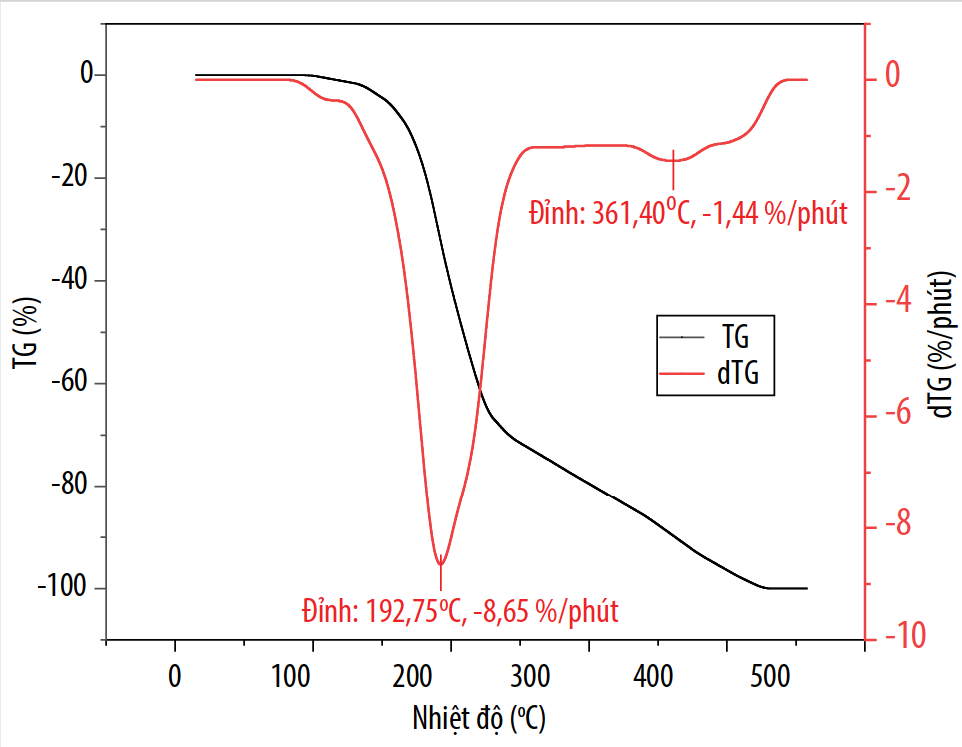
Nghiên cứu nhằm đánh giá ảnh hưởng của lignosulfonate đến thời gian đặc quánh và cường độ nén của xi măng với hàm lượng sử dụng là 0,639% BWOC. Phổ IR cho thấy lignosulfonate có cấu trúc rõ ràng gồm vòng thơm và nhóm sulfonate. Phổ EPR chứng minh lignosulfonate vừa làm tăng độ nhớt, giảm tốc độ hydrate hóa, vừa tham gia tương tác hóa học trong xi măng. Phổ TGA và DTG cho thấy lignosulfonate phân hủy theo 2 giai đoạn, bắt đầu mạnh từ 190°C, chịu nhiệt tương đối cao. Các thử nghiệm theo API Spec.10A và RP 10B- 2 cho thấy mẫu dùng lignosulfonate có độ tách nước thấp hơn (0,552%) so với mẫu dùng HR-14LM (0,644%), cường độ nén UCA của cả 2 hệ vữa đều đạt 500 psi trước 8 giờ. Độ rỗng trung bình giảm từ 20,814% xuống 18,147% và độ thấm giảm từ 0,033 mD xuống 0,006 mD khi dùng lignosulfonate. Thời gian quánh đạt 100 Bc của 2 mẫu lần lượt là 6 giờ 5 phút và 6 giờ 8 phút.
Các tài liệu tham khảo
[2] Yaqin Zhang, Feng Huo, Yanlei Wang, Yu Xia, Xin Tan, Suojiang Zhang, and Hongyan He, “Theoretical elucidation of β-O-4 bond cleavage of lignin model compound promoted by sulfonic acid-functionalized ionic liquid”, Frontiers in Chemistry, Volume 7, 2019. DOI: 10.3389/fchem.2019.00078.
[3] Thomas Aro and Pedram Fatehi, “Production and application of lignosulfonates and sulfonated lignin, ChemSusChem, 2017, DOI: 10.1002/cssc.201700082.
[4] Borregaard, “Cement retarders and dispersants for zonal isolation”. [Online]. Available: https://www. borregaard.com/markets/energy-resources/oil-gas/ applications/cement-retarder.
[5] Nanlong Hong and Xueqing Qiu, “Structure- adsorption behavior-dispersion property relationship of alkyl chain cross-linked lignosulfonate with different molecular weights”, ACS Omega, Volume 5, Issue 1, pp. 109 - 118, 2020. DOI: 10.1021/acsomega.9b03535.
[6] Bernt O. Myrvold, “A new model for the structure of lignosulphonates: Part 1. Behaviour in dilute solutions”, Industrial Crops and Products, Volume 27, Issue 2, pp. 214 - 219, 2008. DOI: 10.1016/j.indcrop.2007.07.010.
[7] Bernd Schäfer, Naturstoffe in der chemischen Industrie. Springer Spektrum, 2006. DOI: 10.1007/978-3- 662-61017-6.
[8] P.J. Salazar Valencia, L.E. Bolívar Marinez, and S.T. Pérez Merchancano, “Molecular modeling of ammonium, calcium, sulfur, and sodium lignosulphonates in acid and basic aqueous environments”, Brazilian Journal of Physics, Volume 45, Issue 6, pp. 567 - 574, 2015. DOI: 10.1007/ s13538-015-0364-5.
[9] Guro Elise Fredheim, Svein Magne Braaten, and Bjørn E. Christensen, “Molecular weight determination of lignosulfonates by size-exclusion chromatography and multi-angle laser light scattering”, Journal of Chromatography A, Volume 942, Issue 1 - 2, pp. 191 - 199, 2002. DOI: 10.1016/S0021-9673(01)01377-2.
[10] Benrt O. Myrvold, “The polyelectrolyte behavior of randomly branched lignosulfonates”, Tappi Journal, Volume 6, Issue 11, pp. 10 - 14, 2007.
[11] Yonghong Deng, Yuan Wu, Yong Qian, Xinping Ouyang, Dongjie Yang, and Xueqing Qiu, “Adsorption and desorption behaviors of lignosulfonate during the self-assembly of multilayers”, BioResources, Volume 5, Issue 2, pp. 1178 - 1196, 2010.
[12] Mingfang Yan, Dongjie Yang, Yonghong Deng, P.Chen, Haifeng Zhou, and Xueqing Qiu, “Influence of pH on the behavior of lignosulfonate macromolecules in aqueous solution”, Colloids and Surfaces A: Physicochemical and Engineering Aspects, Volume 371, Issue 1 - 3, pp. 50 - 58, 2010. DOI: 10.1016/j.colsurfa.2010.08.062.
[13] H. Li, Y. Deng, H. Ye, L. Xiao, and X. Qiu, “Effect of temperature on polyelectrolyte expansion of lignosulfonate”, BioResources, Volume 10, Issue 1, pp. 575 - 587, 2015.
[14] Jost Ruwoldt, “A critical review of the physicochemical properties of lignosulfonates: Chemical structure and behavior in aqueous solution”, Surfaces, Volume 3, Issue 4, pp. 622 - 648, 2020. DOI: 10.3390/ surfaces3040042.
[15] Ligninchina, “Sodium lignosulfonate-sulfite pulping byproduct”, 2025. [Online]. Available: https:// www.ligninchina.com/sodium-lignosulfonate-sulfite- pulping-byproduct/.
1. Tác giả giao bản quyền bài viết (tác phẩm) cho Tạp chí Dầu khí, bao gồm quyền xuất bản, tái bản, bán và phân phối toàn bộ hoặc một phần tác phẩm trong các ấn bản điện tử và in của Tạp chí Dầu khí.
2. Bằng cách chuyển nhượng bản quyền này cho Tạp chí Dầu khí, việc sao chép, đăng hoặc sử dụng một phần hay toàn bộ tác phẩm nào của Tạp chí Dầu khí trên bất kỳ phương tiện nào phải trích dẫn đầy đủ, phù hợp về hình thức và nội dung như sau: tiêu đề của bài viết, tên tác giả, tên tạp chí, tập, số, năm, chủ sở hữu bản quyền theo quy định, số DOI. Liên kết đến bài viết cuối cùng được công bố trên trang web của Tạp chí Dầu khí được khuyến khích.