Potential products from CO2 in line with Vietnam's energy transition trends
Abstract
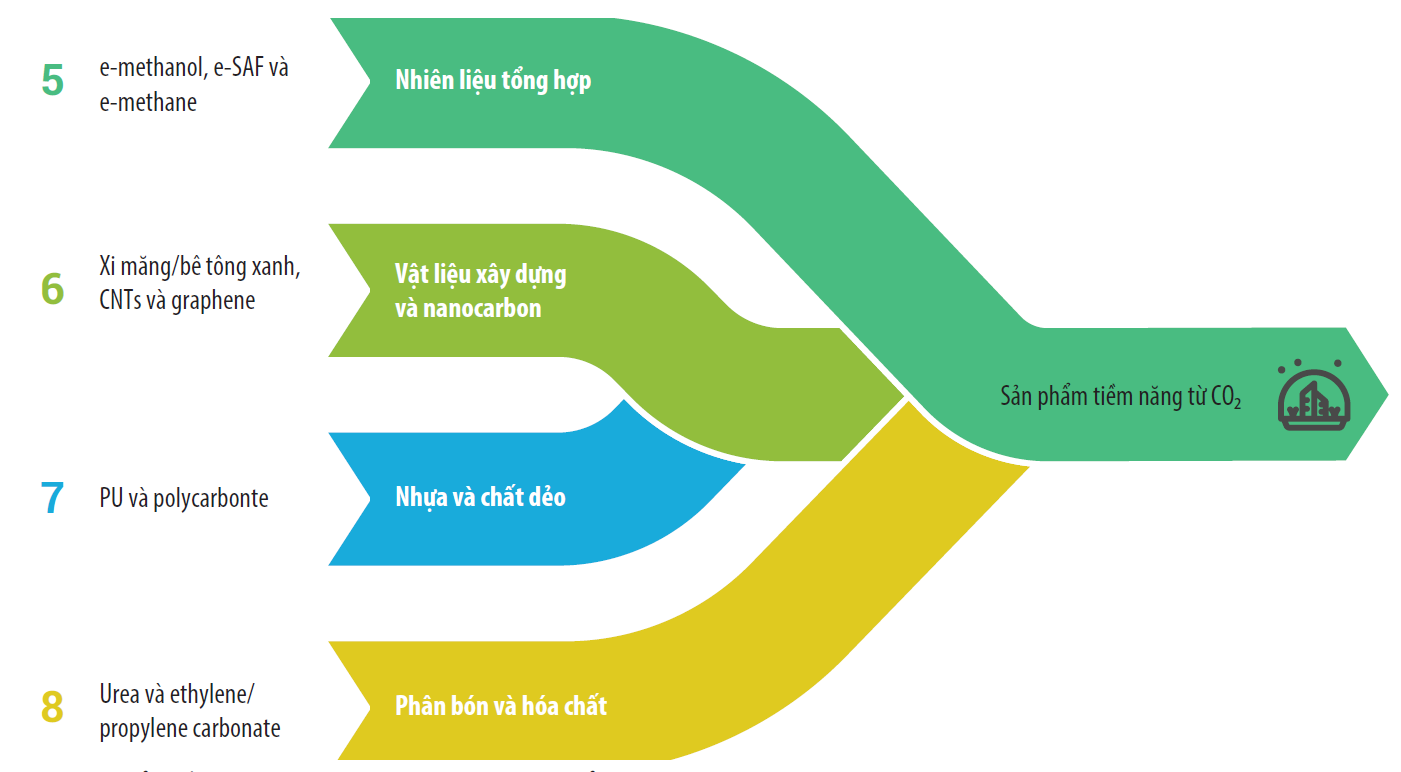
Promising pathways for CO₂ utilisation include the production of urea, synthetic fuels, polymer materials, nanocarbons, green chemicals, and green building materials. The analyses and assessments presented herein outline a clear picture of the potential development of CO₂-derived products in Vietnam toward 2030, 2040, and 2050 - in the context of the country's progressive energy transition, its commitment to achieving Net-zero emissions by 2050, and its pursuit of a low-carbon economy. Through 2030, CO₂-derived products will remain predominantly conventional (urea), already manufactured at existing fertilizer plants in Vietnam. It should be noted, however, that the current CO₂ feedstock for urea production is primarily sourced from within the plants' own process streams - specifically from natural gas reforming or coal gasification processes. Novel technologies for converting CO₂ into products that substitute fossil-based counterparts are currently being deployed mainly at pilot scale for techno-economic assessment. From 2030 onwards, as CO₂ conversion technologies gradually mature and improve in techno-economic performance, new CO₂-derived products will progressively displace their conventional equivalents in the market; the volume of CO₂ required for such new products is projected to reach approximately 5.3 and 24.5 million tonnes per year by 2040 and 2050, respectively. Achieving 20% of these potential values would be broadly comparable to the Government's targets and roadmap for carbon capture, utilisation, and storage (CCUS). Nevertheless, realizing the full potential of CO₂ utilisation remains highly dependent on technological progress, production cost reductions, and the policy mechanisms governing the uptake of these products.
References
IMARC, Vietnam methanol market report by application (formaldehyde, dimethyl ether, gasoline, chloromethane, MTBE/TAME, acetic acid, and others), and region 2026 - 2034, 2025.
Rystad Energy, “Sustainable aviation fuel: The fastest growing energy sector?”, 19/2/2024.
IATA, Global feedstock assessment for SAF production: Outlook to 2050, 2025.
Học viện Chiến lược, bồi dưỡng cán bộ xây dựng và Trung tâm Nhiên liệu xanh toàn cầu (GCGF), Hội thảo quốc tế "Nhiên liệu hàng không bền vững (SAF): Khung chính sách và phát triển thị trường tại ASEAN", 2026.
Thủ tướng Chính phủ, Chương trình hành động về chuyển đổi năng lượng xanh, giảm phát thải khí các-bon và khí mê-tan của ngành giao thông vận tải, Quyết định số 876/QĐ-TTg ngày 22/7/2022.
Avinor, “The SAF product journey: Barriers and opportunities for establishing a SAF supply chain in Norway”, 12/2025.
Civil Aviation Authority of Singapore (CAAS), “Sustainable air hub blueprint”, 12/5/2026.
CSIRO, “Sustainable aviation fuel roadmap”, 2023.
Department for Transport, “The SAF mandate: An essential guide”, 19/12/2024.
European Union Aviation Safety Agency (EASA), 2026 report: ReFuelEU aviation annual technical, 2025.
Government of France, France - Public policy to stimulate SAF production, 2025.
International Energy Agency (IEA). Norway sustainable aviation fuel blending mandate: In line with EU ReFuelEU frameworks, 2025.
Japan Petroleum Energy Center (JPEC), Overview of Japan's sustainable fuels policy and the METI 10% SAF mandate by 2030, 2025.
Ministry of Land, Infrastructure and Transport, “South Korea’s SAF expansion drives climate action and market leadership”, 10/9/2024.
Official Journal of the European Union, “Regulation (EU) 2023/2405 of the European Parliament and of the Council of 18 October 2023 on ensuring a level playing field for sustainable air transport (ReFuelEU Aviation)”, 31/10/2023.
U.S. Department of Energy, U.S. Department of Transportation, and U.S. Department of Agriculture, “SAF grand challenge roadmap: Flight plan for sustainable aviation fuel”, 2022.
International Trade Administration, “Malaysia energy sustainable aviation fuel”, 30/12/2025.
White & Case, “Australia’s DCCEEW issues consultation on potential SAF mandate”, 24/8/2026.
Yuchao Xu, Yahua Zhang, Xin Deng, Anming Zhang, and Hang Yu, “Navigating the trilemma of sustainable aviation fuel development in China: Status and prospects”, Transport Policy, Volume 180, 2026. DOI: 10.1016/j.tranpol.2026.104035.
IEA, “World energy outlook 2025”, 12/11/2025.
Ze Ran and Weisheng Zhou, “Greenhouse gas emissions and economic analysis of e-methane in Japan and China”, Sustainability, Volume 17, Issue 8, 2025. DOI: 10.3390/su17083681.
Roland Berger, “Feasibility and potential of e-methane in the future energy mix”, 22/4/2025.
Danish Sunasra, “E-methane: A promising low-carbon alternative to natural gas”, 6/5/2025.
Jachin Gorrea, Felix Ortloff, and Charlotte van Leeuwen, “Production costs for synthetic methane in 2030 and 2050 of an optimized Power-to-Gas plant with intermediate hydrogen storage”, Applied Energy, Volume 253, 2019. DOI: 10.1016/j.apenergy.2019.113594.
HAN Corporation, “Bê tông bẫy carbon (carbon-curing): vật liệu xanh cho ngành đúc sẵn”, 21/10/2026.
IMARC, “Vietnam cement market size, share, trends and forecast by type, end use, and region, 2025 - 2033”.
The Graphene Council, “Virtual Graphene Investor Conference”, 24 - 25/2024.
Grand View Research, “Carbon nanotubes market (2025 - 2030)”.
Maheshika H.K. Premarathna, Dominik Keiner, and Christian Breyer, “Techno-economic assessment of electricity-based graphene production from atmospheric carbon dioxide as a potential negative emission option”, Journal of Cleaner Production, 2026.
Conor O’Brien, “Surging CNT capacity enables applications beyond Li-ion batteries”, 22/11/2023.
Marcus Johnson, Jiawen Ren, Matthew Lefler, Gad Licht, Juan Vicini, Xinye Liu, and Stuart Licht, “Carbon nanotube wools made directly from CO2 by molten electrolysis: Value driven pathways to carbon dioxide greenhouse gas mitigation”, Materialstoday Energy, Volume 5, pp. 230 - 236, 2017. DOI: 10.1016/j.mtener.2017.07.003.
TechSci Research, “Vietnam polycarbonate market by type (polycarbonate sheets, polycarbonate tubes/pipes, polycarbonate films, others), by end user (electrical & electronics, automotive, building & construction, aerospace & defense, medical, optical, others), by region, competition, forecast and opportunities, 2018 - 2028F”.
Farah Bani Affan, “Direct reaction of carbon dioxide to polycarbonate”, Journal of Ecosystem & Ecography, 2016. DOI: 10.4172/2157-7625.1000185.
ReportLinker, “Vietnam polyurethane industry outlook 2022 - 2026”.
Mobility Foresights, “Vietnam polyurethane market size and forecasts 2030”, 26/4/2025.
Caroline Paul, “Global green fertiliser tracker: Greening nitrogen fertiliser production. Agora Industry”, 6/6/2024.
IEA, “Ammonia technology roadmap: Towards more sustainable nitrogen fertiliser production”.
IRENA, “Innovation outlook: Renewable ammonia”.
Kirin Capital, Báo cáo thị trường phân bón Việt Nam, 2024.
Thủ tướng Chính phủ, Chiến lược quốc gia về biến đổi khí hậu giai đoạn đến năm 2050, Quyết định số 896/QĐ-TTg ngày 26/7/2022.
Grand View Research, Ethylene carbonate market (2026 - 2033), 2026.
Market Research Future, “Propylene carbonate market”.
Thủ tướng Chính phủ, Đề án thành lập và phát triển thị trường các-bon tại Việt Nam, Quyết định số 232/QĐ-TTg ngày 24/1/2025.
Thủ tướng Chính phủ, Tổng hạn ngạch phát thải khí nhà kính thí điểm cho năm 2025 - 2026, Quyết định số 263/QĐ-TTg ngày 9/2/2026.
Chính phủ, Sửa đổi, bổ sung một số điều của Nghị định số 06/2022/NĐ-CP ngày 07/1/2022 của Chính phủ quy định giảm nhẹ phát thải khí nhà kính và bảo vệ tầng ô-dôn, Nghị định số 119/2025/NĐ-CP ngày 9/6/2025.
BloombergNEF, “Net-zero transition: Opportunities for Vietnam”, 23/12/2024. [Online]. Available: https://assets.bbhub.io/professional/sites/24/BNEF_VietnamNZS_EN.pdf?.
Minghui Zhang, Yanan Jiang, Huimin Zhang, Rui Xing, Ningyan Li, Zhengxuan Shao, Yuan Liu, and Xiaoying Xu, “The techno-economic analysis of renewable methanol”, Clean Energy, Volume 10, Issue 1, pp. 56 - 77, 2026. DOI: 10.1093/ce/zkaf061.
Ehsan Soroodan, Sanger Huang, Dia Milani, Ali Kiani, and Paul Feron, “Techno-economic assessment of green urea production integrated with direct air capture”, Energy Conversion and Management: X, Volume 26, 2025. DOI: 10.1016/j.ecmx.2025.101015.
Bộ Công Thương, Điều chỉnh quy hoạch tổng thể về năng lượng quốc gia thời kỳ 2021-2030, tầm nhìn đến năm 2050, Quyết định số 363/QĐ-BCT ngày 28/2/2026.
1. The Author assigns all copyright in and to the article (the Work) to the Petrovietnam Journal, including the right to publish, republish, transmit, sell and distribute the Work in whole or in part in electronic and print editions of the Journal, in all media of expression now known or later developed.
2. By this assignment of copyright to the Petrovietnam Journal, reproduction, posting, transmission, distribution or other use of the Work in whole or in part in any medium by the Author requires a full citation to the Journal, suitable in form and content as follows: title of article, authors’ names, journal title, volume, issue, year, copyright owner as specified in the Journal, DOI number. Links to the final article published on the website of the Journal are encouraged.